Photos that work well for silhouettes, and photos that need more work
A good silhouette source has a recognizable outer shape. This guide uses published SilMaker outputs to show why visible limbs, contrast, and separation matter, and where automatic selection needs review.
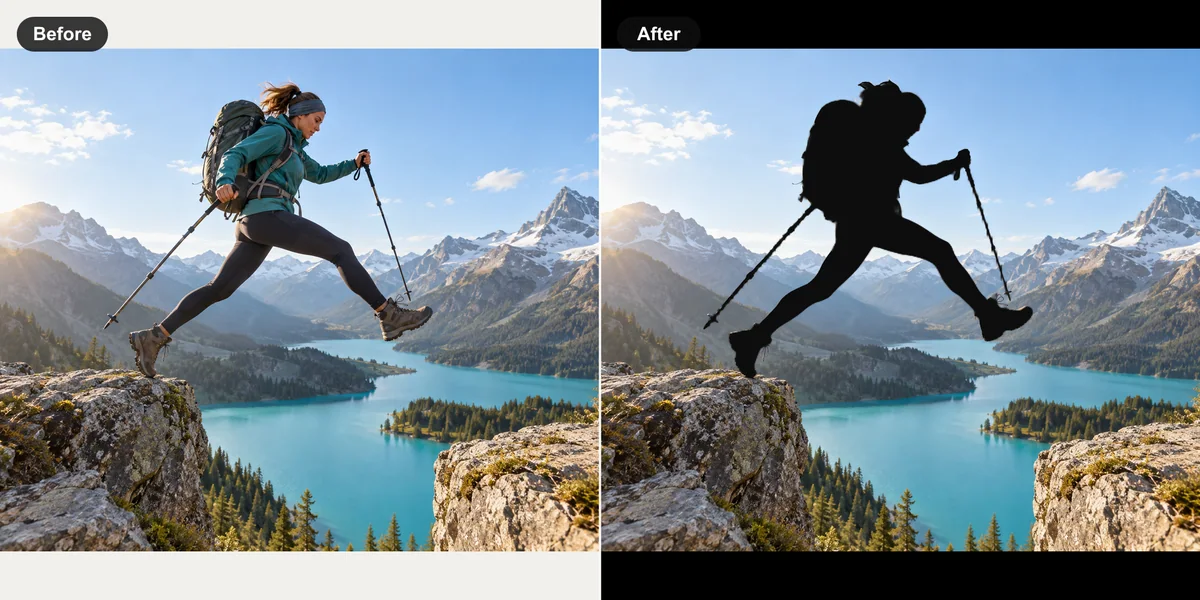
Open the free converterA strong source keeps the whole pose visible
Look for one main subject with clear space around its outer edge. A backpack, raised arm, tail, or bicycle can be part of the clue when it remains inside the source frame.
This does not mean every outdoor photo is easy. Contrast changes across water, trees, and shadows can still affect individual edges.
Crowded connections create ambiguity
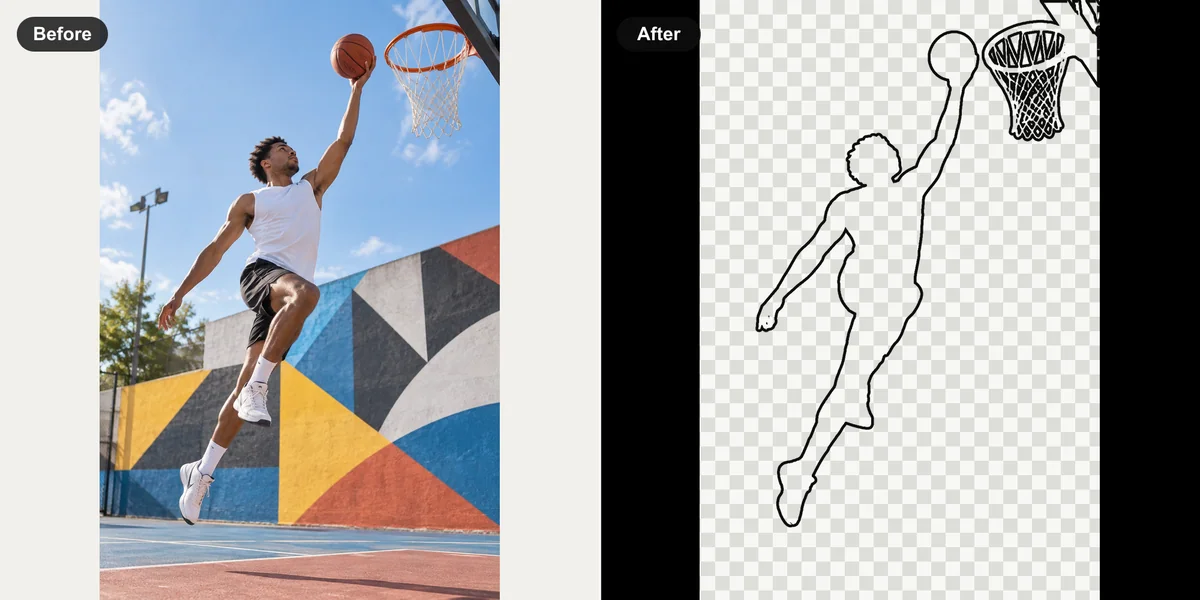
When a subject touches equipment, another person, or a similarly colored background, the detector can treat connected pixels as one shape. The result may be usable if the connected object belongs in the composition, or it may need a local correction.
Do not promise a perfect automatic cutout for hair, transparent material, reflections, low contrast, or overlapping subjects.
Use the first result as a decision point
After processing, inspect the outline at the places that carry recognition: ears, hands, feet, wheel gaps, handles, and the space between limbs. Decide whether a small correction preserves the intended subject.
Choose another source when a missing feature is outside the frame or when separating it would require inventing an edge that the photo does not show.
Match the output to the job
A filled silhouette works when the outer mass is the message. An outline can preserve more of the original scene but also exposes noisy mask edges. Transparent output is useful for later layout, while a white background is useful for a fixed worksheet or print page.
Every result is a raster PNG. Plan for its final size before using it in a large poster or precision-cut workflow.
Frequently asked questions
Can Smart Brush fix a cropped foot or tail?
No. It can refine nearby selected areas, but it cannot recover a feature outside the original image.
Are generated examples proof of every user photo?
No. The examples document particular test inputs and actual outputs. Your image can differ in contrast, overlap, resolution, and subject shape.