Remove a background and keep the original subject colors
Background removal keeps the detected subject's original colors and texture while making the surrounding pixels transparent. It reuses the current SilMaker mask; changing between silhouette and background removal should not require a new subject-detection pass for the same image.
Remove a backgroundWhat this result preserves
The source is the documented original explorer-robot image. The final PNG preserves the robot's original RGB appearance only where the existing SilMaker mask is opaque or partially transparent; the surrounding background is transparent.
This is different from a silhouette. A silhouette deliberately replaces the subject with one chosen color. Background removal retains the source appearance inside the selected subject.

Use the current mask across both tools
Color, style, and background choices change the rendered output. They do not need a fresh subject-detection pass when the source and editable mask have not changed.
Replacing the original image starts a new processing session because its pixels and subject boundary are different.
- Choose an image and wait for SilMaker to create its editable mask.
- Inspect or correct the mask before changing output mode.
- Switch between silhouette and background removal without replacing the source image.
- Download the transparent PNG only after checking its edge against the intended background.
Check transparency on more than one background
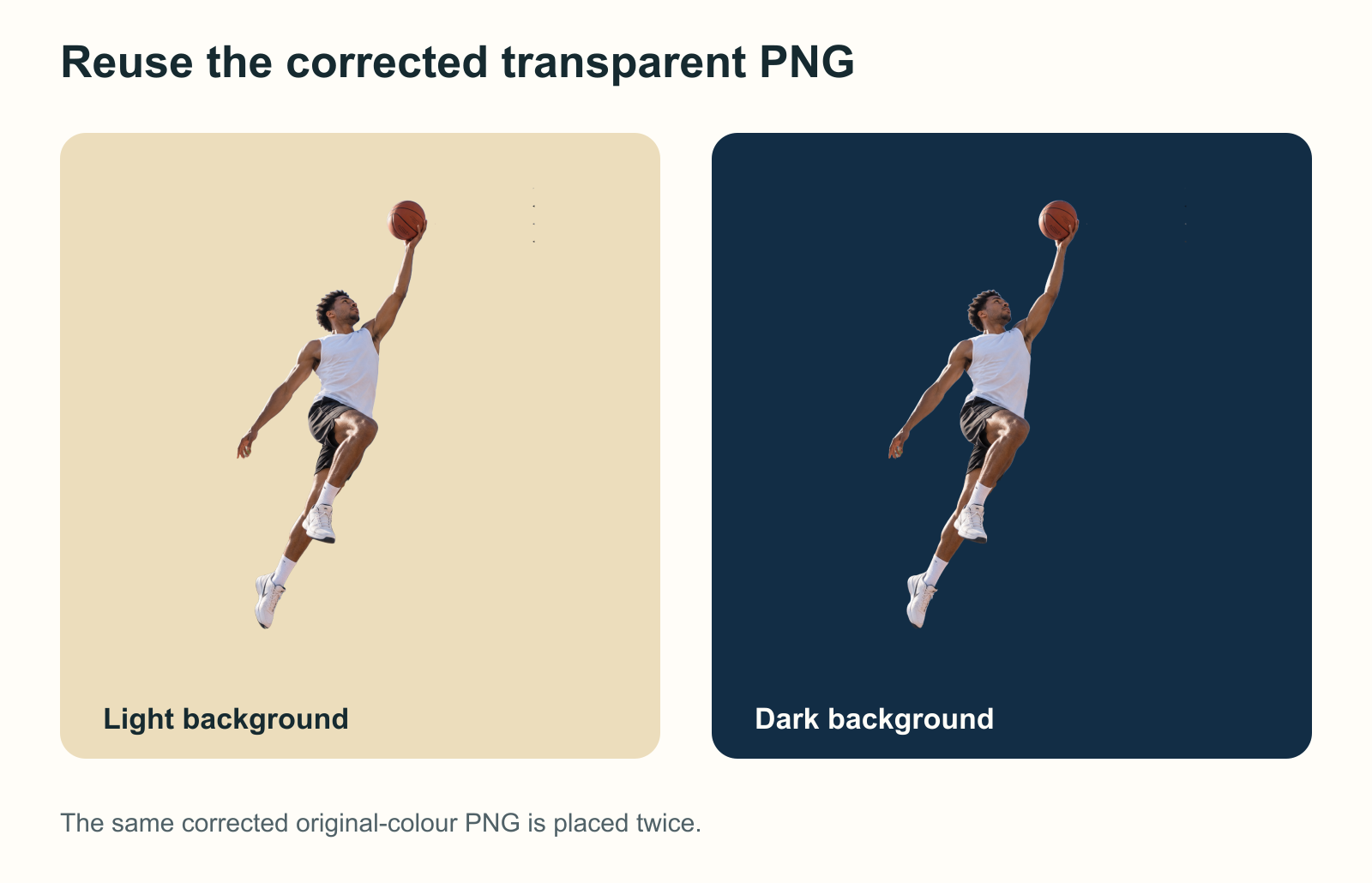
A checkerboard indicates transparent pixels but cannot reveal every halo, light edge, or lost detail. Place the same PNG over both a light and dark background before deciding that the boundary is ready.
The downloaded file is transparent PNG. The new background colors shown here were added only for inspection and layout.
Correct only what the source supports
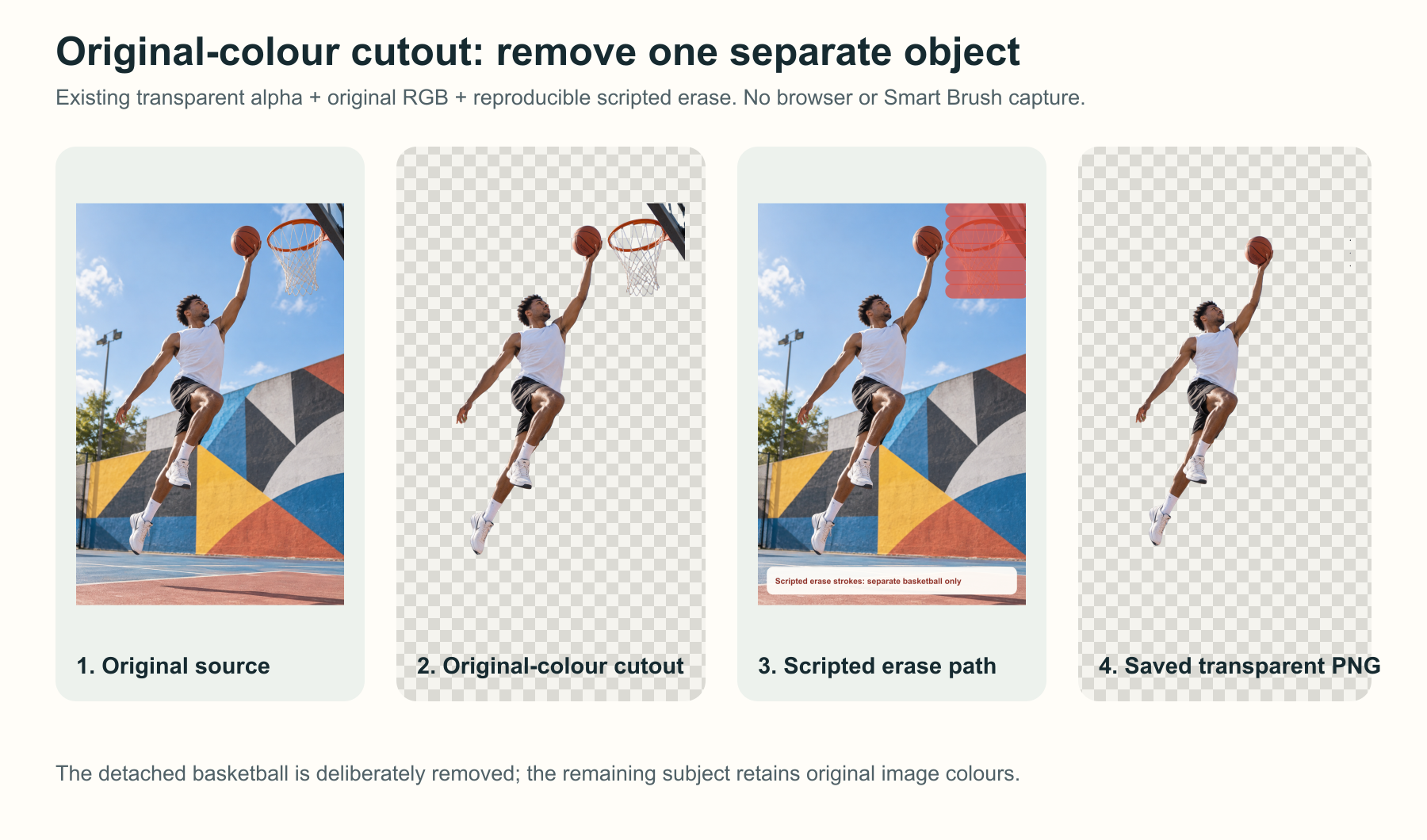
This documented basketball example uses its matching actual transparent SilMaker export as foreground alpha, then applies that alpha to the source RGB pixels. Seven fixed source-pixel erase paths remove the detached basketball component; the person component ends separately before that area. The corrected alpha is then composited back into an original-colour transparent PNG with the production pixel functions.
Use Add for a missing connected part and Remove for remaining background. Start with Precision or Tight for small edges, then use Balanced or Wide only when the connected area needs more context.
This example removes a separate object; it does not demonstrate a white-shadow correction or a new inference run. Fine hair, transparent objects, reflections, low contrast, overlap, and parts outside the source frame can remain difficult. A brush cannot recreate an edge that is absent from the original image.
Frequently asked questions
Does background removal keep the original colors?
Yes. It retains source RGB pixels inside the current foreground alpha, while the surrounding pixels are transparent.
Does switching modes run subject detection again?
Not for the same source image and current mask. Switching output mode re-renders from the existing state.
Is this a new model result?
No. The documented example reuses a recorded SilMaker transparent export's alpha with the source RGB pixels.